
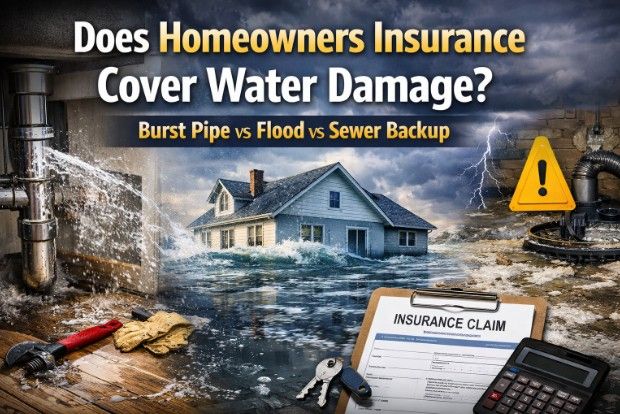
For many homeowners, the realization that their insurance policy has a massive “blind spot” usually comes at the worst possible time: while they are standing in several inches of water inside their living room.
There is a pervasive myth that a “comprehensive” or “all-perils” homeowners policy covers any type of water damage. This is fundamentally false. In the insurance industry, the distinction between a “water claim” and a “flood claim” is a multi-thousand-dollar difference. To protect your home and your financial stability, you must understand the technical truth about how insurers define and exclude flood damage.
The Hard Truth: The Standard Exclusion
The short answer is no. A standard homeowners insurance policy (specifically the HO-3 policy, which is the most common in the United States and similar formats globally) explicitly excludes damage caused by “flooding.”
Insurance companies categorize flooding as a “catastrophic risk.” Because floods can affect thousands of homes simultaneously, private insurers traditionally found it too risky to include in a standard policy without charging prohibitively high premiums. As a result, flood insurance was separated into its own distinct product.
Insuring Your Electric Vehicle: How EV Insurance Differs from Gas CarsHow Insurers Define a “Flood”
To understand why your claim might be denied, you must understand the insurer’s definition of a flood. In technical terms, a flood is defined as an excess of water on land that is normally dry, affecting two or more acres or two or more properties.
The “Rising Water” Rule: The most important distinction is the direction of the water.
- If water comes from above (such as rain entering through a hole in the roof caused by a fallen tree, or a pipe bursting in the upstairs bathroom), it is generally covered by your homeowners insurance.
- If water comes from the ground up (such as a river overflowing, a heavy storm causing surface water to seep through the foundation, or a storm surge), it is classified as a flood and is excluded from your homeowners policy.
Common Scenarios Where Homeowners Are Unprotected
Many homeowners are surprised to find that the following common events are usually not covered by a standard policy:
1. Heavy Rainfall and Surface Runoff
If a sudden downpour causes water to pool in your yard and eventually flow into your basement or through your front door, this is considered surface water. Without a specific flood policy, you are responsible for the total cost of repairs.
Small Business Insurance 101: What Every Entrepreneur Needs to Protect2. Mudflows
While many people associate floods with clear water, “mudflows” (rivers of liquid and flowing mud on the surface of normally dry land) are also excluded from homeowners insurance and are instead covered under flood insurance.
3. Storm Surges
For those living near the coast, the water pushed inland by a hurricane or tropical storm is classified as a flood. Even if the wind damage to your roof is covered, any damage to the ground floor caused by the rising ocean is not.
The Solution: Where to Get Flood Coverage
Since your standard policy won’t help, you have two primary avenues for securing protection in 2026.
1. The National Flood Insurance Program (NFIP)
Managed by FEMA, the NFIP is the most common provider of flood insurance. It is available to anyone living in a participating community, regardless of whether they are in a high-risk or low-risk zone.
What Is Umbrella Insurance and Do You Really Need It?- Limits: NFIP policies typically cap coverage at 250,000 dollars for the structure and 100,000 dollars for personal property.
- The 30-Day Rule: This is critical. NFIP policies usually have a 30-day waiting period from the date of purchase before they become active. You cannot buy a policy when a storm is already on the horizon and expect to be covered.
2. Private Flood Insurance
In recent years, the private flood insurance market has expanded significantly. Private insurers often offer higher limits than the NFIP and may include “Loss of Use” coverage (paying for your hotel if you cannot live in your home), which the NFIP does not provide. Private policies also occasionally have shorter waiting periods, sometimes as low as 10 to 14 days.
A Note on Sewer Backups
There is a “gray area” that often confuses homeowners: sewer backups. If a heavy rain causes the local sewer system to overflow and back up into your home’s drains or toilets, this is often excluded from both a standard homeowners policy AND a standard flood policy.
The Fix: You must add a specific “Sewer Backup Endorsement” to your homeowners policy. It is a low-cost add-on that provides a specific limit of coverage (e.g., 5,000 to 25,000 dollars) for this specific peril.
Do You Need Flood Insurance If You Are Not in a “High-Risk” Zone?
One of the most dangerous phrases in real estate is “I don’t live in a flood zone.” Technically, everyone lives in a flood zone; the question is simply whether you are in a high-risk, moderate-risk, or low-risk area.
Why Was My Insurance Claim Denied? How to Appeal the DecisionAccording to FEMA, more than 20% of all flood insurance claims come from people living in low-to-moderate risk areas. In 2026, as urban development creates more “impermeable surfaces” (concrete and asphalt) that cannot absorb rainwater, flash flooding is becoming common in areas that have historically been dry.
If you are in a low-risk zone, a “Preferred Risk Policy” is often very affordable—sometimes costing less than 500 dollars per year—and provides a massive financial safety net.